Artikuj
The Albanian Files reveals the moral blindness of architects in their quest for design freedom
It sounds like a dream for any architect: a head of government who is obsessed with architecture, invites foreign firms, awards commissions, and personally intervenes in the design process. In Albania, thanks to Edi Rama, that dream became a reality. ‘The Albanian Files’, an 800-page book covering twenty years of foreign architecture in the country, highlights above all the unique relationship between architecture and power. It is, therefore, a revealing portrait of a profession that confuses the absence of democratic oversight with design freedom. (originally published in De Architect, August 2026)
Truman Capote said of On the Road, the legendary book that Jack Kerouac managed to write – with the aid of amphetamines and a continuous roll of typewriter paper – in a single stream of consciousness: ‘that’s not writing, it’s just typing’. For The Albanian Files, the massive tome published on twenty years of foreign architecture and urban planning in Albania, edited by Anneke Abhelakh at Lars Müller Publishers, something similar applies: ‘that’s not editing, it’s just printing’
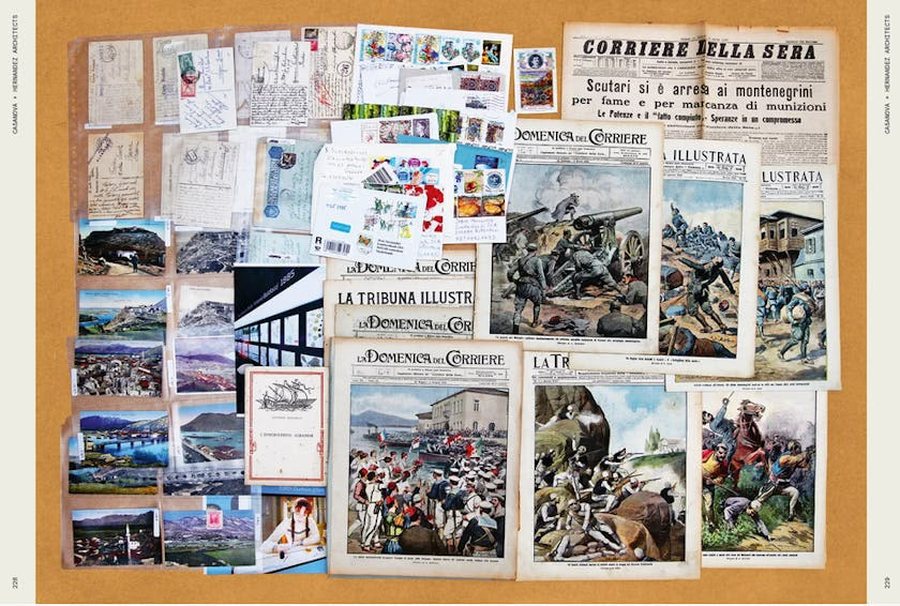
Sixty architectural practices from Europe, America and Asia were sent a form with questions about how long, how and why they work in Albania, whether they would like to complete a spreadsheet with details of their projects, and subsequently an invitation to fill an 8- or 16-page section with drawings, sketches, ideas, photographs or whatever else they wished to showcase.
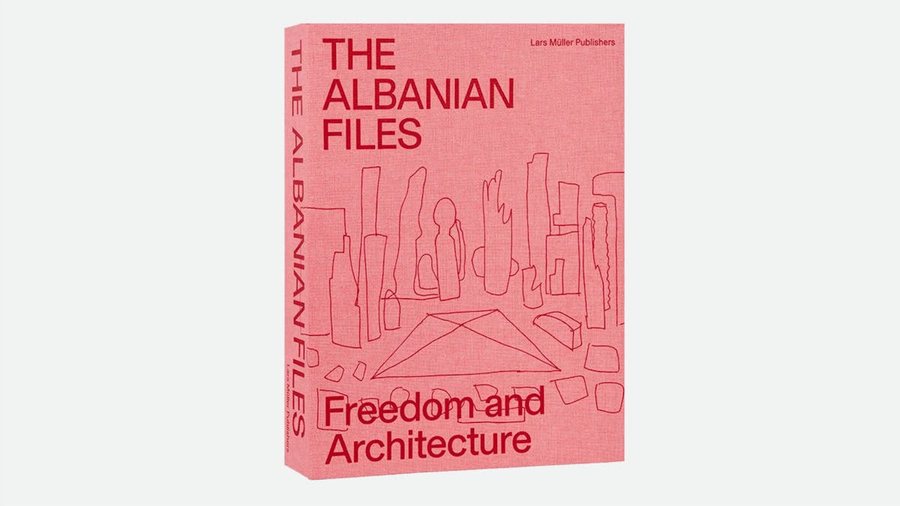
Telephone directory
That is more or less what the NAi010 editors do in the first few hours of the process leading up to the publication of the Yearbook of Architecture. Based on the material requested, the editorial team then embarks on a hundreds-of-hours-long odyssey to visit all the projects, discuss which projects should be included and which should not, select images and design drawings, or commission them to be produced, write informative texts to accompany each project, and reflect on the output of a single year in architecture in a series of in-depth essays.
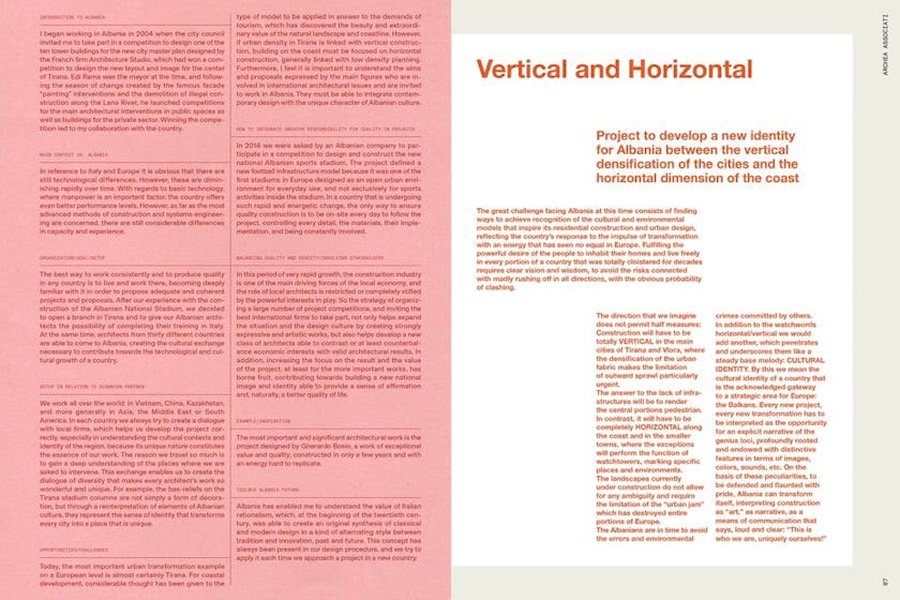
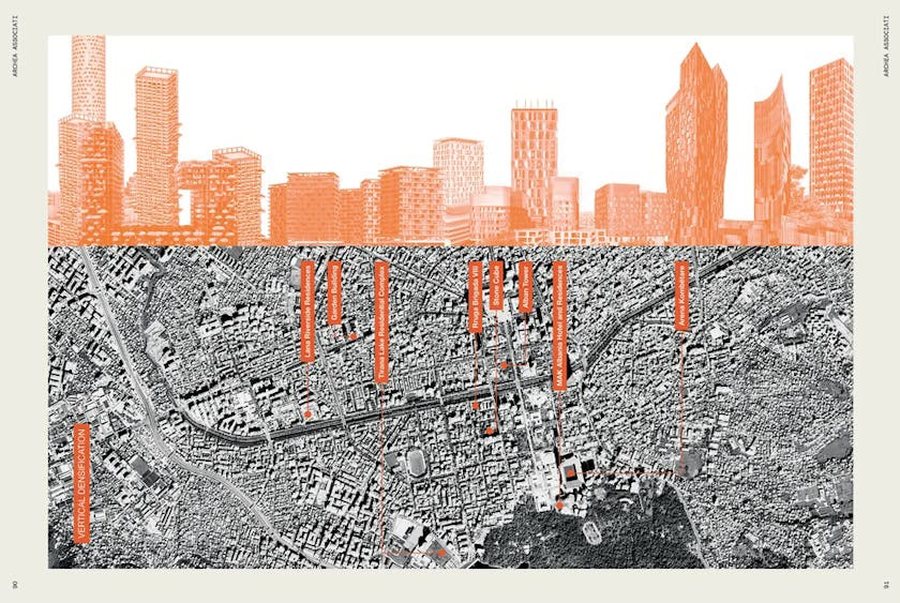
Lars Müller Publishers and Abhelakh have skipped all these stages. They confined themselves to compiling the material into an 800-page telephone directory, structured based on the output from the forms and spreadsheets, printed on pink paper. The whole is preceded by an introduction by Anneke Abhelakh, who writes in extremely general terms about themes such as collaboration, exchange and community.
The foreword is by Edi Rama, the Prime Minister of Albania, who has been in power for 13 years and, before that, served as mayor of Tirana for many years. In a short, bombastic text, he praises the heroic role of his ‘army of foreign architects’ (Arch Army) in liberating the Albanians from their isolation and deprivation, and in preparing them for their role in the EU and the world. Incidentally, during the period that Rama has been in power, amongst other things, there has been an enormous brain drain, with hundreds of thousands of young and highly educated Albanians leaving for Europe and the rest of the world.
This diaspora, including that of architects, has been prevented from playing any significant role in the projects compiled in this book. The book has taken on a political dimension far greater than that of any other book on architecture, and it stands in stark contrast to the minimal editorial effort and reflection invested in it. It is a book that cannot really be taken seriously in terms of content, but which, as both a symptom and a symbol of the relationship between architecture and power, is nevertheless worth studying.
An architecture book at the heart of a political struggle
The Albanian Files was published when the streets of Tirana were filled with Albanians shouting and singing at the top of their voices in protest against the corruption of the Rama government and, in particular, the close ties of the Prime Minister – who, as mayor, was already dubbed ‘Mister 10 per cent’ – with oligarchs, shady foreign investors and the laundering of criminal money through property. In a country that for decades has seen tens of thousands of people emigrate each year and is slowly being depopulated, one exorbitantly expensive apartment block after another is being built, only to stand empty because their primary function is the laundering of cocaine money.
The final straw was a project in which Jared Kushner played a leading role, to build over the Sazan Island nature reserve and the Vjosa-Narta lagoon with an exclusive resort for the very wealthiest. The blurring of lines between Kushner the property developer and his role as a family member and adviser to Donald Trump on Gaza – which in turn became entangled with Edi Rama’s ambition to curry favour with both Trump and the reconstruction of Gaza through the Board of Peace, on which Rama is one of the only European leaders to sit, and for which he claims he wishes to deploy his ‘Arch Army’ – created such an inextricable tangle of corruption, environmental destruction, power politics and the support for war and genocide, that the Albanians took to the streets en masse.
Ivanka Trump’s in Albania Because birds nest in the lagoon, the protest took on the name ‘Flamingo Revolution,’ and demonstrators walk around with pink placards shaped like a flamingo. They were protesting against the entire system, characterized by crime, nepotism, and the erosion of democratic values, with Edi Rama as the spider at the center of the web.
The Flamingo Revolution follows the pattern of another mass protest against a corrupt and authoritarian leader: the Gezi Park protests in Turkey in 2013. The plan was to build a neo-Ottoman-style shopping center over the popular Gezi Park in central Istanbul. The first demonstrators came out to defend the park and oppose the sell-off of public space. Still, the protest soon spread to the corrupt and undemocratic way Recep Erdogan was forcing through his massive construction projects.
Ultimately, millions protested across the country against the dismantling of secular and democratic rights and institutions by the Islamist government. In Turkey, the protests ended in brutal and violent repression by the army, resulting in many deaths.
Occupy Gezi, Istanbul 2013, Publicspace.org In Albania, judicial institutions still operate independently, and the government has not yet used large-scale violence, so things need not end as they did in Turkey. However, Edi Rama has already said nothing can topple him from his throne.
According to him, this involves a small minority of agitators paid by foreign powers. He also believes that, thanks to him, the country has never been in a better state than it is now. Albania can forget about ever being admitted to the EU should he resign.
Book as a political weapon. And then the book was published, with the provocative title The Albanian Files: Freedom and Architecture, and the protests were presented with a symbol on a plate. A book featuring nothing but foreign architects, all of whom had been commissioned, through Edi Rama’s direct intervention, to realize a whole series of random iconic projects, including some of the most eye-catching examples of corruption and money laundering, which, with their bizarre shapes, have come to dominate Tirana’s skyline.
The comparison with The Epstein Files was quick to be drawn. A website that revealed tens of thousands of pages of legal documents documenting the corruption of the Rama government was titled The Edi Rama Files. The living legend Fatos Lubonja, a writer and former political prisoner under the Stalinist regime, launched a project to systematically document the abuse of power and resources through which every project mentioned in the book came into being.
Edi Rama struck back by using the book as a political manifesto for his struggle to liberate Albania from decades of backwardness and isolation, with the help of architecture. To draw an even larger crowd — but this time in support of him — Edi Rama had a temporary stadium built for a single concert by Kanye West, whom he presented as The Albanian Files in front of the assembled photographers. Here, too, he opted for foreign glamour to bolster his own standing. He could, of course, have asked Dua Lipa, but the British-Albanian superstar later spoke out in favor of the Flamingo protests and against Edi Rama.
Flamingo Protests, with a concrete ‘birthday cake’, topped by models of skyscrapers by MVRDV and Alejandro Aravena Architects are becoming dependent on Edi Rama. The book attracted even more attention when a member of the opposition in parliament quoted from the contribution by Reinier de Graaf of OMA. De Graaf wrote an open letter to the Prime Minister, urging him, if necessary, to dissolve parliament and not hold any further elections, provided he could remain in power.
Foreign architectural practices such as those featured in The Albanian Files, including De Graaf himself, had, in a world where architecture was increasingly losing ground, become entirely dependent on their personal relationship with Rama. Fair elections and a change of government would be disastrous for architecture, according to De Graaf.
According to the MP, this was the ‘smoking gun’ proving just how corrupt and authoritarian Rama’s regime actually is and what the hidden agenda of his politics is. In response, both the book’s editor and Edi Rama argue that the reaction proves how little his opponents have grasped the irony, and that including De Graaf’s blatantly satirical letter demonstrates how open and transparent they are.
Whilst demonstrators and dissidents view the book as a document of the shamelessness of corruption under Edi Rama, Rama and his editor present its brazenness as something positive. Editor Anneke Abhelakh stated in response to a critical piece on Archined that the book does exactly what archives and files are meant to do: mark a moment of broad societal debate.
Precisely because they have become the focal point of a protest against the corrupt government, The Albanian Files are a manifesto for the Freedom to hold differing opinions. It is interesting to see how shamelessness can take various forms. The theatrical and vulgar manner in which Edi Rama further inflates the controversy and shouts back as loudly as possible, and the way in which Abhelakh tries to smooth over the contradictions in a soothing but inimitable line of reasoning. It is Donald Trump versus Mark Rutte, former Prime Minister of the Netherlands for 13 years and current Secretary General of NATO who famously called the President of the USA ‘Daddy’.
Edi Rama and Secretary General of NATO Mark Rutte, Ankara july 8, 2026 Freedom and Architecture – or Freedom for Architecture? The editor has given the book the subtitle Freedom and Architecture’, apparently on the basis that this is a unifying theme amongst the motley collection of projects in the book. The Freedom to which they refer, judging by Rama’s foreword, Abhelakh’s introduction and the reflections of many architects, is architecture as a sign of liberation from the constraints and isolation of the Stalinist regime that fell 35 years ago.
Consequently, it is precisely this apparent arbitrariness, the spatial chaos, unbridled capitalism, and even crime and corruption that are given a certain luster, namely that of the ‘newly’ acquired Freedom to experiment, whereby things can sometimes get a bit rough, but you know…. It is as US Defense Secretary Donald Rumsfeld said after the looting of the Iraqi Museum of Antiquities: ‘Freedom’s untidy, and free people are free to make mistakes and commit crimes and do bad things. They’re also free to live their lives and do wonderful things. And that’s what’s going to happen here.’
Architects as useful idiots
As is often the case with leaders who have been in power for too long, Rama has come to equate the interests of Albania with his own position. He sees himself as the only one capable of guiding the Albanians in shaking off what he calls the trauma of liberation – the sudden opening of the doors and windows and the confusion that follows. Father Rama must therefore lead with a firm hand, even if the Albanians don’t quite understand it at the moment and allow themselves to be manipulated by enemies of the people. ‘The greatest threat to Albania is the Albanians themselves’, as he said only recently.
Whilst the Sun King’s narcissism entirely consumes Ramam, the architects and the editor play the role of the ‘useful idiot’, a term Soviet politicians used for the communist sympathizers from the West who came to support the construction of the workers’ utopia – including many an architect.
After all, it requires a specific kind of stupidity on the part of architects to be able, 35 years after the fall of communism, to dismiss the corrupt chaos within which they work as the inevitable growing pains of a country struggling to break free from its past, and to view Edi Rama as the enlightened leader without whom the country could never reinvent itself.
Both in terms of the chosen editorial format and the projects themselves, there is, in The Albanian Files, no trace to be found of a collective substantive approach, shared spatial analysis or a hierarchy between main and secondary issues, which one would expect from a country where power over architecture is so centralized.
A certain coherence can be discerned within the contributions from practices active in Albania for twenty years and organized chronologically, such as those by Rotterdam-based City Förster and the Belgian 51N4E. Yet even these remain series that barely complement or intersect with one another.
The vast majority of the contributions do not rise above the anecdotal and subjective, with outliers representing the most personal expressions of the most personal emotions, which various designers did not wish to withhold from us.
Stupidity
In fact, the stupidity of Rama’s Arch Army is the only ‘fabric’ that holds the projects together and forms the book’s raison d’être. At the level of stupidity, we see all manner of common threads and convergences, shared views and a consensus – however incongruous – regarding the role of architecture and the nature of Rama’s government.
I use the word ‘stupidity’ deliberately, not to provoke or offend. In an extremely incisive piece for equator.org, the Palestinian writer Abdalwajad Omar examines why so many erudite, worldly, intelligent critics both within and outside Israel nevertheless, time and again, find ways to minimize, deny or gloss over Israel’s genocide against Palestinians, to deny it or to conceal it. He observes how they do this by drawing on the repertoire of intellectual debate, whilst setting aside substantive logic, proportionality, context and reasonableness.
He calls this moral stupidity, and distinguishes it from ignorance, which is not a choice, but also from cowardice, which involves a personal risk that one is unwilling to take. Moral stupidity, according to Omar, is the choice to stop thinking, reasoning, and analyzing, so as not to be confronted with the abyss of personal responsibility that comes with complicity in a state of injustice.
Omar’s ‘stupidity lens’ provides a sharp picture of the choices and rhetoric of the architects in Albania. They are not mad or stupid, nor are they a priori criminal. Nor is it the case that, together with Edi Rama, they are carrying out a carefully prepared conspiracy. Rather, the context in which they work has allowed several peculiarities and logical fallacies endemic to the profession of architecture to develop into catastrophic blind spots.
I have attempted to list these pitfalls, which led to blind spots and which in turn led to moral stupidities à la Abdaljawad Omar. 1. The stupidity of the first-person form. Firstly, the first-person form is stupid. I have never read an architecture book in which the word ‘I’ is used as frequently as in The Albanian Architect.
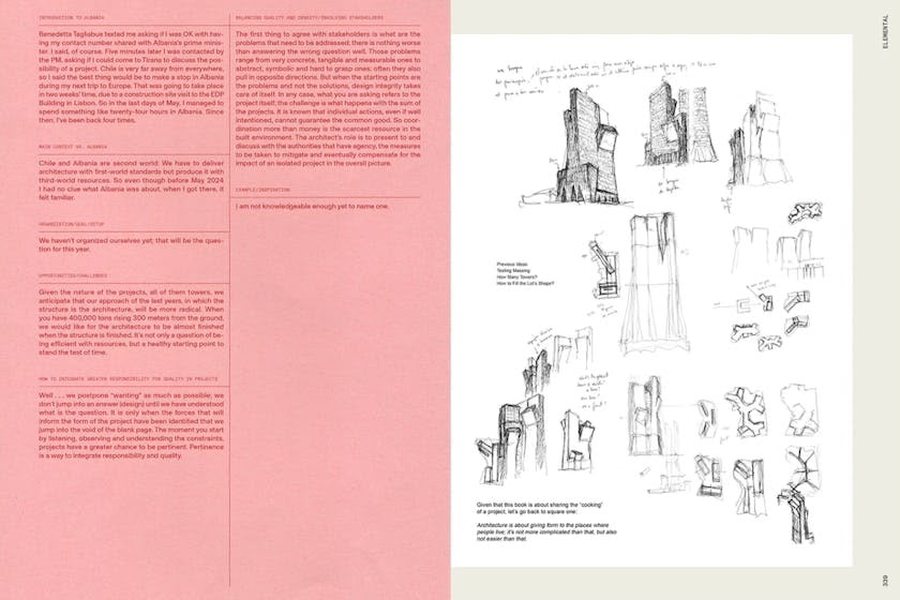
1. The stupidity of the first-person form. Firstly, there is the stupidity of the first-person form. I have never read an architecture book in which the word ‘I’ is used as frequently as in The Albanian Files. From the answers to the questionnaire to the reflections on one’s own project, everything is subjective, intuitive, direct, and emotional. This ranges from ‘I received a call from Edi, who’d got my number from Benedetta (Alejandro Aravena)’, to ‘I was walking through Tirana with my binoculars and saw a butterfly (Jeanne Gang)’, or ‘I can’t come to Albania because my back is playing up (Alvaro Siza)’.
My mum used to do yoga exercises under a bamboo canopy in Indonesia so that this beach resort will be made of bamboo – or perhaps not. (Elora Hardy). Despite all the lip service paid to collaboration, to a joint project, to the departure of the star architect, the architects are actually mainly talking about themselves. This is further emphasized in the book by including the nicknames of several architects in the pages containing general information. For instance, Sam Chermayeff likes to be called ‘Chechen Gangster’ and NOA ‘The Mediterranean Mountaineers’ – and that’s what it says in this book.
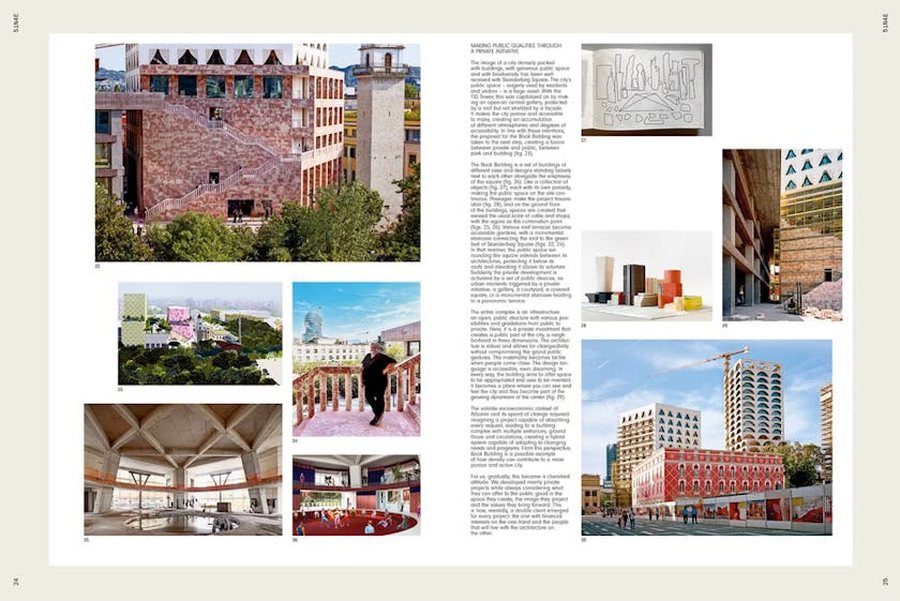
2. The absurdity of the sketch. Secondly, there is the absurdity of the sketch. A very large proportion of the contributions consists of scans of the architects’ spontaneous doodles, in which I can almost see, in real time, the creative juices flowing and seeping until they solidify, for example, into a skyscraper with a twisted floor plan (Pablo Bofill) or a façade shaped like butterfly wings (Jeanne Gang).
Pablo Bofill, The Barcelona Tower, Tirana Despite all the talk about the importance of process, participation, and co-creation, the conception of the project is determined by the very first sketch, wherever or whenever it is. This may be done by an architect who has not even visited the country, nor will he ever visit it (Siza), or by an architect who, even before she has spoken to a single local expert, nevertheless sketches out a town of 50,000 inhabitants in a distinctly expressionist graphic form on large rolls of tracing paper (Anupama Kundoo).
The “Kingcoast” project and one of Narta’s masterplans, by Kundoo and Archea studio, Citizens.al Steven Holl has even had one of his spontaneous curls enlarged thousands of times so that it now forms the whimsical silhouette of a large building, which is actually being built.
Steven Holl, Expo Albania, Steven Holl Architects 3. The stupidity of the tourist. Thirdly, there is the stupidity of the tourist. Dozens of architects reach the same conclusion: the most important context to which they must relate is that of the landscape, and in particular the mountains and the sea, which, as Liz Diller observes, in Albania is always aquamarine. From Porto, Álvaro Siza once again sketches how beautifully the Albanian rocks plunge into the sea, whilst Winka Dubbeldam draws inspiration from the rock faces when designing vegetation-covered beveled façades for skyscrapers in the heart of Tirana.
Other architects find pebbles on the beach that inspire them to build a huge beach resort shaped like enormous rocks (Berton). It is this very same stupidity that leads many an architect to point to the hospitality of ‘the Albanians’ and the many courses that make up the lunches they enjoy.
4. The stupidity of the colonialist. Fourthly, there is the stupidity of the colonialist. In the introduction and in many of the contributions, there is talk of the particularly valuable exchange between foreign architects and local firms. However, this is not defined as an exchange during the creative process, but as a way of realizing the building using local resources. This exchange is expected to kick off a learning process so that, in a few years, local architects will meet the standards of foreign architects and be able to design buildings independently.
What the foreign architects do wish to learn, however, are the ancient crafts of ‘The Albanian’: sheep herding (Cityförster), basket weaving, stone stacking, woodcarving – which, after all, can lead to new and striking façade cladding, for example on an airport terminal (Archea).
Developing a cross sectoral approach to sustainable tourism development in Albania, Cityfoerster.net Likewise, the specific folding patterns in traditional costume can inspire the folded façade of a skyscraper. Just as with the romantic platitudes about the landscape, Albania is here too portrayed as an unspoiled paradise, devoid of citizenship, politics or architecture, but filled with folklore, traditional dress and craftsmanship, waiting in ignorance for the fruits of progress. It is Orientalism in its purest form.
5. The stupidity of nationalism. And then there is the stupidity of nationalism. This is illustrated above all by MVRDV’s projects. Winy Maas had previously said in a presentation that he and Edi Rama wanted to work together to ‘make nationalism sexy again’.
This began with proposals to paint huge ‘I love Albania’ onto buildings, followed by proposals to paint the double black eagle against a red background across the entire building, followed by proposals to design an immense block of flats with a series of cantilevered flats that, together, would protrude from the building like a three-dimensional map of the country.
The pinnacle of MVRDV’s ‘sexy nationalism’ is the ‘Skanderbeg Building’, a ninety-meter-high luxury apartment complex shaped like the head of the father of the nation: the fifteenth-century warlord Skanderbeg. In Skanderbeg, a nationalist myth was created in the nineteenth century portraying him as the protector of Christian Europe against the Asian hordes from the Ottoman Empire. To give the immense head, resting on an immense neck and shoulder, the correct and convincing anatomical form, Winy Maas modeled the national hero’s entire body as a 500-meter-high digital sculpture.
All this serves, drawing on the country’s history, to create buildings that provide identity — or so it is explained. The reality is that, even though a Dutch architect may talk about nationalism as if it were a matter of city branding, nationalism in the Balkans has a long history. Invoking six-hundred-year-old bloody battles, such as those in which Skanderbeg defeated the Turks, has by no means proved innocent in this region over the past thirty years.
MVRDV, Skanderbeg building, Tirana Moreover, it overlaps with Edi Rama’s self-appointed role in fortifying Fortress Europe against invaders from the east and south, as seen in the detention centers for asylum-seekers that he is having the Italian government build on his territory, and in his support for Israel’s war of extermination against the Palestinian people.
Furthermore, it is clear to everyone in Albania that the towering figure with the pointed beard, the bald head, and the glare is in fact the Prime Minister himself, the reincarnation of Skanderbeg.
What was conceived as an MVRDV-esque architectural joke involving a national symbol can, within this context and on this scale, be described as nothing other than fascist architecture. I have two arguments in favour of this position, drawn from George Mosse’s ‘The Nationalisation of the Masses’ (1975) Firstly, no likeness is being created of a national symbol, nor is a building being dedicated to that symbol; rather, a building is being constructed that is itself a giant embodiment of the national symbol, in which national identity and the leader coincide, but which is also so large that it can hold hundreds of people, thereby causing the people and the leader’s body to coincide in a single structure.
That is fascist architecture. The symbol of national unity, which embodies the origins and essence of the Albanian people, is moreover realized on such a scale and situated in such a central location that no one can escape the gaze of Skanderbeg. That, too, is fascist architecture. With the Skanderbeg Building (also known as ‘Tirana’s Rock’), MVRDV has designed a fascist building. Whether the architects intended it that way is irrelevant. Sometimes things are what they are.
6. The stupidity of the architecture. The final stupidity, and the prerequisite for the functioning of the first five stupidities, is the stupidity of the architecture. The entire ‘Albania’ project by Rama and his ArchArmy is caught up in a Faustian pact between those in power and the architect. We see this expressed in the many words of praise the architects direct at the leader, in the apologies offered by both Abhelakh and Rama, but also in the anecdotes about the initial contacts between the architects and Mayor Rama, and subsequently Prime Minister Rama. ‘If you come here to build, I’ll make sure that you get the commissions and that nothing stands in the way.’ He said this, literally or to that effect, dozens of times to architects – often young at first, but later also experienced ones – whose project had not been selected in a design competition, or who had been recommended to him by another architect. Rama’s charm is legendary, as are his taste and his familiarity with architectural jargon.
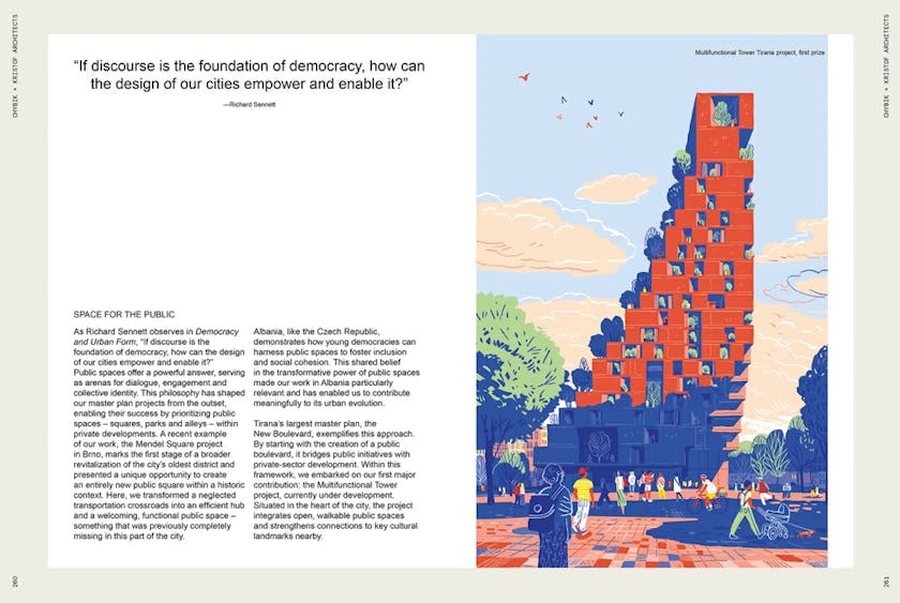
The architects accepted his invitation because they believed good architecture was crucial to the country’s reconstruction, and that they could play an indispensable role in it. Almost everyarchitect in the book maintains that good architecturecan only be realised through ahead of government who truly believes in architecture andis personally committed to architecture, andto the choices made by architects. Rama theatrically dismisses the objections of property developers or his own civil servants in a theatrical manner, and grants exemptions from planning regulations and other restrictions laid down in law. All for the sake of architecture. It is the folly of architecture to equate its own interests with those of society. It thus denigrates society’s concerns in comparison with those of architecture. The book is called *Freedom and Architecture*, but it is in fact about Freedom for Architecture. At last free from rules and laws, at last commanding the respect of developers, at last valued by politicians. Rama is good for architecture and architecture is good for the world.
Too fast, too cheap
But even within the terms of the pact with Rama, architecture does not always come off well. Ideas aren’t hindered, but that also means projects often move too quickly, too cheaply, and incorrectly, causing them to start crumbling after the photographers have left. This is acknowledged by many of the architects in the book, but dismissed as a learning process, as growing pains, as something that will only get better once Albanian builders catch up on their technical shortcomings – in other words, as confirmation of Albania’s backwardness and of the need for good architecture.
The second problem is that Rama has not only struck a deal with the foreign architects, but also one with the property developers, investors and construction companies. ‘Work with these architects, and I’ll let you build whatever you want, wherever you like, with whatever money you need to set aside,’ says the Prime Minister to the oligarchs, the cocaine traffickers and the foreign powers.
In this way, Rama can present himself to the outside world, particularly the EU, as an enlightened leader, a ‘super-mayor’ who realizes one cultural and ecological project after another with foreign architects. For Albania, this means Rama and his ArchArmy act as gatekeepers for the investment and laundering of tens of billions by Albanian oligarchs.
7. Legal stupidity. And therein lies the problem for the architects, which might well be described as legal stupidity. Normally, the architect’s role in shady construction projects is completely ignored. Carel Weeber said as long as twenty years ago that the fact that no architect had been invited to the parliamentary inquiry into construction fraud showed just how marginalized the architectural profession had become.
With The Albanian Files in hand, Albanians are crying out for justice, and an extensive forensic investigation is underway. Local journalists and critics have been writing for over ten years about the cesspit of corruption and criminality in which the architects find themselves. They have even approached architectural firms on several occasions to warn them. That is, in any case, progress compared to the construction fraud inquiry.
Until recently, the designers had believed they would be overlooked and that they had not been knowingly involved. However, the latter is not always a sufficient defense in prosecutions for corruption and money laundering. It is no wonder that many of the architects featured in the book have already engaged solicitors to prepare for the legal storm that will undoubtedly follow.
Freed from the rule of law
But legal matters fall entirely outside the scope of a book review. What does fall within it is this: the Freedom the architects have experienced whilst building in Albania is, in fact, Freedom from the democratic rule of law. They are free from nature conservation, from rules on transparency. From consultation with skeptical and critical civil servants, with activists who are committed to preserving this and restoring that, or with tendering rules originating from the EU.
They are liberated from an anonymous bureaucracy that applies equally to everyone, without regard to person. They are freed from the monumental disinterest in architecture they encounter from local politicians and clients. They are freed from the principles of constitutional democracy, such as the idea that politics should not, in fact, become personally involved with the substance of architecture, art, or other forms of culture.
Through their actions, the architects demonstrate their conviction that only through an enlightened dictatorship can good architecture emerge, and that good architecture is worth sacrificing democratic principles for. This is not only a tactical mistake that will cost them dearly in all sorts of ways, but also a betrayal of the Albanian people, who for months have been speaking out en masse for democracy and the rule of law.
What does working in Albania say about our architects
? But what does it actually say about the architects from our own region, that in their enthusiasm for Edi Rama’s political machine they turn their backs on the principles upon which the institutions of the EU are based? They themselves say they regard corruption as the growing pains of a country in transition and that architecture plays a positive role in Albania’s normalization.
But there is little sign of this transition. Moreover, the excited tone of the architects in their contributions to the book rather suggests that they wish to hold up Albania as a positive example for Europe. In the interviews with the architects in Albanian Calls, the film accompanying the book, directed by Anneke Abelaakh, some architects’ boasting seems to come straight from the manosphere.
Perhaps the architects’ obsession with Rama is not merely opportunism, but also a symptom of a yearning for social transgression, for rising above the petty morality of bourgeois society. Edi Rama presents Albania as a place where the profession of architecture can be experienced with passion, without constantly having to take others into account.
In any case, it is clear that Albania’s future does not lie with Edi Rama and his architects. It may take a long or short time, but this regime will come to an end. The demonstrations have already secured their first victory: revising the image we have of Albania. Whereas Albania used to be completely identified with Edi Rama, it is now defined by the resistance against him. The country’s iconic image is no longer Edi Rama’s head, in photographic or architectural form, but boulevards and squares filled with people carrying flamingos.
But that is merely the first step. Now that the focus is on the resistance, attention is also being paid to the abundance of books, Substack articles, investigative journalism and PhD theses on what is happening in the country, and it is becoming apparent that there is an enormous level of intelligence and idealistic passion among the Albanian people. The demonstrations have also mobilized the diaspora, who have participated en masse in the protests in their motherland. Under Rama, the country has, after all, become completely isolated from the outside world by locking the Albanians behind a wall of inflated neoliberal kitsch, and the Albanians have been systematically belittled as backward and underdeveloped.
After more than a decade of warnings from the Albanian dissident intelligentsia and the odd foreign journalist, the wall of nonsense now finally seems to be crumbling, ironically due to the interference of the Trump crime family. The third step is now for the genuine Albanian civil society—comprising both Albanians at home and in the diaspora- to rebuild itself amidst the ruins of nearly twenty years of Rama. My prediction is that the reinvention of a participatory and transparent democracy will bring with it a resurgence of design intelligence and creativity that will serve as an example to us all.
There may be issues and tasks for which young Albanians will wish to engage specialists from the Netherlands. Who knows, perhaps even architects again one day! But I expect that Albania’s stance will be: ‘Don’t call us. We’ll call you’.
First published in de Architect, 24 August 2026, revised 27 August 2026, in Dutch.
The author's own English version: crimsonwouter.substack.com, 25 August 2026.
Published with the permission of the author.
Illustrations reproduced from the review as first published in de Architect.
Images of the book courtesy Lars Müller Publishers.
Illustrations selected by Arkitektët Shqiptarë.